
Why Interactive Learning is Replacing Traditional LMS Platforms
The Flawed Assumption of the Traditional LMS
For over two decades, the standard Learning Management System (LMS) has operated under a simple assumption: if you host the content, learning will happen.
Traditional LMS architectures were built as digital filing cabinets. They excel at administrative compliance—hosting static PDFs, queuing pre-recorded video lectures, tracking seat time, and logging multiple-choice quiz scores. However, when the goal shifts from passive credentialing to deep technical mastery across engineering, computer science, and quantitative disciplines, the traditional LMS breaks down.
A growing body of cognitive science and educational research confirms what educators and practitioners have long observed: watching someone solve a complex problem is fundamentally different from solving it yourself. As organizations and learners demand real-world execution over passive course completion, interactive learning environments are rapidly replacing legacy LMS platforms.
The Illusion of Competence and the "Doer Effect"
The primary failure of legacy LMS platforms is their reliance on one-way content delivery. When learners watch a polished video lecture or skim a static slide deck, they frequently experience the illusion of competence. Because the instructor’s explanation flows logically on screen, the learner mistakes fluency of observation for personal mastery.
It is only when the learner is asked to architect a system, write a mathematical proof, or debug a failing deployment from a blank slate that the gaps in their mental model become apparent.
In a landmark Harvard University study, Deslauriers et al. (2019) randomized STEM students into either smooth, passive lectures delivered by charismatic instructors or active, interactive problem-solving sessions. The results exposed the core trap of passive video platforms: students in the passive lectures reported a significantly higher "feeling of learning" because watching an expert felt effortless, yet students in the interactive sessions scored markedly higher on actual mastery assessments.
This aligns directly with online platform research from Carnegie Mellon University (Koedinger et al., 2015). By analyzing online course activity to compare passive video watching and page reading against interactive exercises, researchers identified the "Doer Effect": engaging in interactive practice yields a learning benefit more than six times greater (6×6\times6×) than watching additional video lectures or reading static pages.
Similarly, in a comprehensive meta-analysis of 225 studies in undergraduate STEM education, Freeman et al. (2014) demonstrated the stark cost of passive instruction:
Higher Failure Rates in Passive Environments: Students in traditional, passive lecture environments were 1.5 times more likely to fail than students in active, interactive learning environments.
Measurable Mastery Gains: Active problem-solving increased examination and concept-inventory performance by nearly half a standard deviation (0.47 SD0.47\text{ SD}0.47 SD) across all STEM disciplines.
Traditional LMS platforms optimize for frictionless content consumption. Interactive platforms optimize for productive cognitive friction—the exact mental effort required to build durable neural pathways.
The ICAP Framework: Why "Interactive" Beats "Passive"
To understand why interactive platforms outperform static content repositories, cognitive scientist Michelene Chi’s ICAP Framework (Chi & Wylie, 2014) provides a clear hierarchy of cognitive engagement. The framework categorizes learning behaviors into four modes, ordered from lowest to highest retention:
Engagement Mode | Typical Learner Behavior | Legacy LMS Implementation | Interactive Platform Implementation |
|---|---|---|---|
1. Passive (Lowest Retention) | Receiving information without overt action. | Watching a 45-minute pre-recorded video; listening to audio. | Minimized; replaced by concise, structured text and micro-prompts. |
2. Active | Manipulating focus within fixed material. | Pausing a video; highlighting static text; copying notes verbatim. | Navigating structured, searchable knowledge graphs and dynamic references. |
3. Constructive | Generating outputs beyond the provided material. | Rare; usually limited to end-of-module multiple-choice quizzes. | Solving multi-step problems on a live canvas; explaining concepts in own words. |
4. Interactive (Highest Retention) | Co-creating knowledge through dynamic feedback loops and dialogue. | Asynchronous forum posts that go unanswered for days. | Real-time AI and instructor Socratic probing, live collaborative whiteboarding, and immediate state-aware feedback. |
Legacy LMS systems spend 90% of a student's time in the Passive tier and test them abruptly at the end. Modern interactive platforms invert this pyramid, placing the learner immediately into Constructive and Interactive states where every concept is tested, manipulated, and applied in real time.
Closing the Feedback Loop: From Post-Mortem to Real-Time Intervention
In a traditional LMS, assessment is an autopsy. A student completes a module, takes a multiple-choice quiz, receives a score of 65%, and moves on. The platform records what the student got wrong, but remains blind to why their underlying mental model failed.
The single most critical factor separating one-on-one mentorship from passive courses is step-level, immediate feedback. When a learner works through a complex derivation or architectural diagram inside an interactive studio environment:
Granular Error Detection: Instead of waiting for a final multiple-choice selection, an interactive workspace observes the intermediate steps—whether on a live vector/WebGL whiteboard, an interactive code sandbox, or a structured analytical prompt.
Socratic Scaffolding: Rather than simply revealing the correct answer (which short-circuits learning), an interactive environment challenges the specific flawed assumption at the exact moment it occurs.
Adaptive Pacing: Interactive systems dynamically adjust task complexity based on demonstrated execution, preventing both boredom among advanced practitioners and cognitive overload among novices.
Bridging Theory and Execution: The Power of Praxis
In classical philosophy, knowledge is divided into two distinct realms: theoria (theoretical, abstract contemplation) and praxis (the process by which a theory, lesson, or skill is enacted, embodied, and realized in practice).
However, praxis is not mere mindless repetition or mechanical drill. In educational philosophy, praxis represents a continuous, self-correcting cycle: a learner studies a theoretical framework, applies it to a concrete problem, observes the real-time consequences of their actions, and refines their mental model accordingly. True mastery only emerges when theory and action are fused into the same cognitive moment.
Traditional LMS platforms fracture this cycle. They isolate theoria inside passive video lectures and static readings, leaving the learner to figure out praxis entirely on their own outside the platform. Interactive learning platforms—and the foundational philosophy behind Praxium Academy—reunite theory and execution into a single, seamless loop:
Dynamic Knowledge Synthesis: Instead of forcing learners to scrub through hours of linear video to locate a single formula or architectural pattern, modern platforms transform dense textbooks and technical documentation into structured, queryable, and interactive modules where concepts are immediately testable.
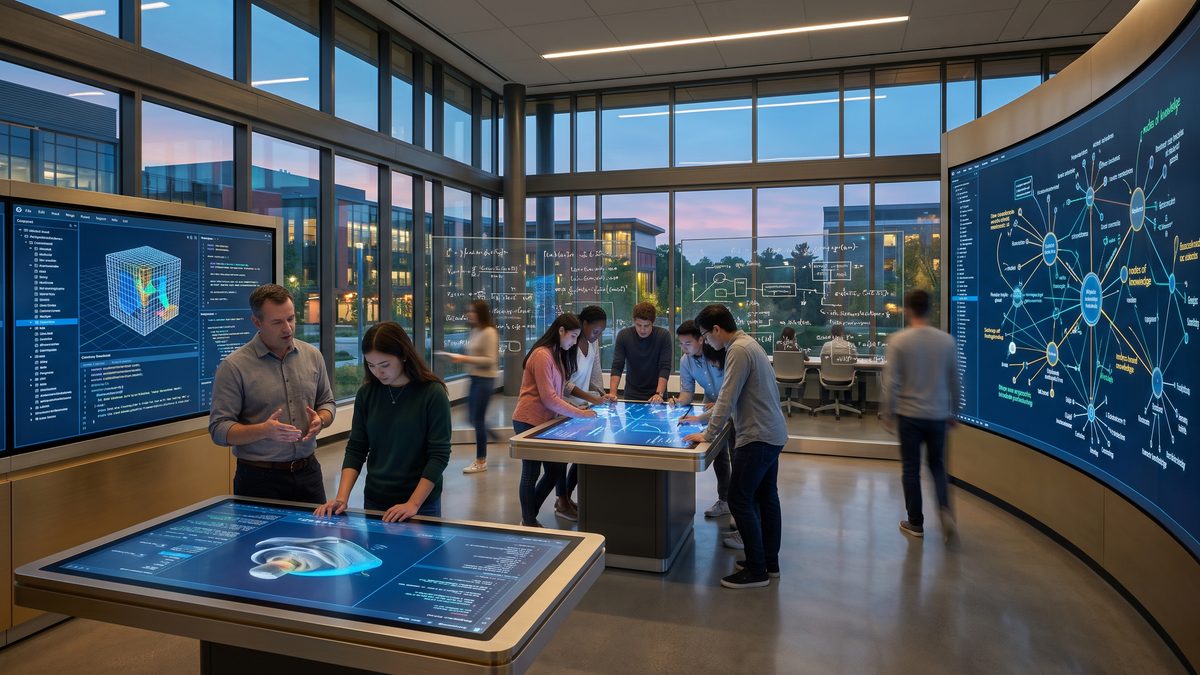
Spatial & Visual Reasoning: Complex STEM concepts rarely live in plain text alone. By integrating live collaborative whiteboards, interactive diagrams, and real-time instructor studios directly into the learning flow, abstract mathematical and engineering theories become tangible objects that learners can manipulate on the spot.
Verifiable Competency Over Seat Time: Replacing passive "Mark as Complete" checkboxes with verifiable, hands-on execution ensures that course completion equates to genuine, applied capability.
The Future Belongs to Kinetic Mastery
The era of the passive digital course catalog is ending. Information itself is abundant; what remains scarce is the structured cognitive environment required to turn raw information into applied wisdom and real-world skill.
By replacing static video queues and multiple-choice guesswork with live interactive workspaces, contextual synthesis, and real-time Socratic feedback, Praxium Academy moves education beyond passive consumption—building a sanctuary where theory immediately becomes praxis.
References & Research Citations
Chi, M. T. H., & Wylie, R. (2014). Active learning outcomes and the ICAP framework of cognitive engagement. Educational Psychologist, 49(4), 219–243.
Deslauriers, L., McCarty, L. S., Miller, K., Callaghan, K., & Kestin, G. (2019). Active engagement and perceived versus actual learning outcomes in STEM classrooms. Proceedings of the National Academy of Sciences (PNAS), 116(39), 19251–19257.
Freeman, S., Eddy, S. L., McDonough, M., Smith, M. K., Okoroafor, N., Jordt, H., & Wenderoth, M. P. (2014). Meta-analysis of active learning performance in science, engineering, and mathematics. Proceedings of the National Academy of Sciences (PNAS), 111(23), 8410–8415.
Koedinger, K. R., Kim, J., Jia, J. Z., McLaughlin, E. A., & Bier, N. L. (2015). Interactive practice versus passive viewing in online learning environments. Proceedings of the ACM Conference on Learning @ Scale, 111–120.
Comments
Sign in to join the discussion.