
The Science of Retention
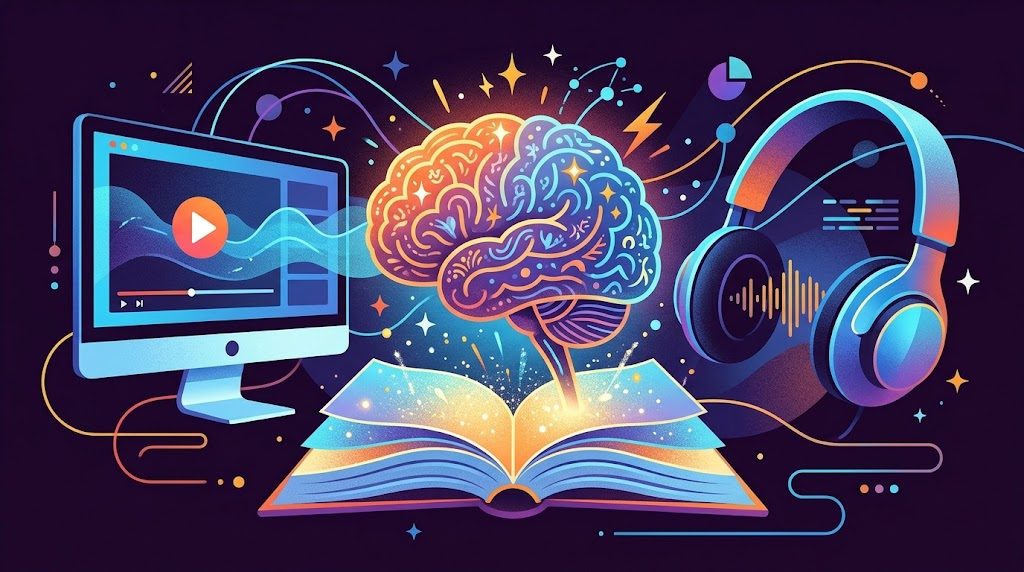
The Science of Retention: Decoding Reading, Video, and Audio for Complex Concepts
When tackling complex, technical, or highly theoretical material, the delivery format fundamentally alters how the brain processes and retains information. While video and audio formats dominate modern digital learning, empirical research demonstrates that text remains the superior medium for deep comprehension and long-term memory consolidation.
The Active Mechanics of Reading
Reading forces the brain into a state of active construction. The prefrontal cortex must decode symbols, translate them into language, and synthesize meaning, which embeds knowledge deeper into memory. Because reading is inherently self-paced, learners can instantly pause, rescan, and mentally connect distant concepts. A 2022 meta-analysis encompassing over 4,600 participants revealed that while audio and text perform similarly for basic recall, reading significantly outperforms audio when tasks require complex inference, exact referencing, or structural navigation [1]. The physical act of reading prevents complex material from flowing past a struggling learner.
Video and the Illusion of Fluency
Video lessons offer valuable visual scaffolding but often induce passive consumption. Because visuals and audio are delivered at a fixed, continuous pace, the cognitive load is managed by the medium rather than the learner. This creates an "illusion of fluency"—students feel they understand the material in the moment because it is easy to watch, but they fail to actively retrieve and store it.
A 2018 experiment conducted by MIT’s Integrated Learning Initiative (MITili) tested learning outcomes between video and text mediums. Reading yielded higher average assessment scores (82.5%) compared to video (81.3%) [2]. Crucially, the MIT study found that text was drastically more effective for non-native English speakers, who outscored their native-speaking reading counterparts by 20 percentage points because they could control the pace of their translation and comprehension. Video excels at illustrating temporal processes, but it falls short when learners need to parse dense logical arguments.
Audio: Linear Access vs. Deep Processing
Audio delivery provides unparalleled accessibility and is highly effective for linear narratives or familiar review. However, auditory processing is highly susceptible to mind-wandering and prevents spatial review. Learners cannot easily "skim" audio or jump back to a specific formula or dense paragraph without breaking their cognitive flow. For complex learning involving equations, spatial relationships, or heavy terminology, relying solely on audio removes the visual anchors necessary to build a mental framework.
For maximum retention of difficult material, text should serve as the primary instructional foundation. Video should be deployed surgically to illustrate specific mechanical or spatial processes, and audio reserved for supplemental review, ensuring the brain engages in the active retrieval necessary to make complex knowledge stick.
Citations
[1] Clinton-Lisell, V. (2022). Listening Ears or Reading Eyes: A Meta-Analysis of Reading and Listening Comprehension Comparisons. Review of Educational Research.
[2] Nelson, S. (2018). Compared to reading, how much does video improve learning outcomes? MIT Integrated Learning Initiative (MITili).
Comments
Sign in to join the discussion.