
Beyond Coding: How AI is Reshaping STEM Careers
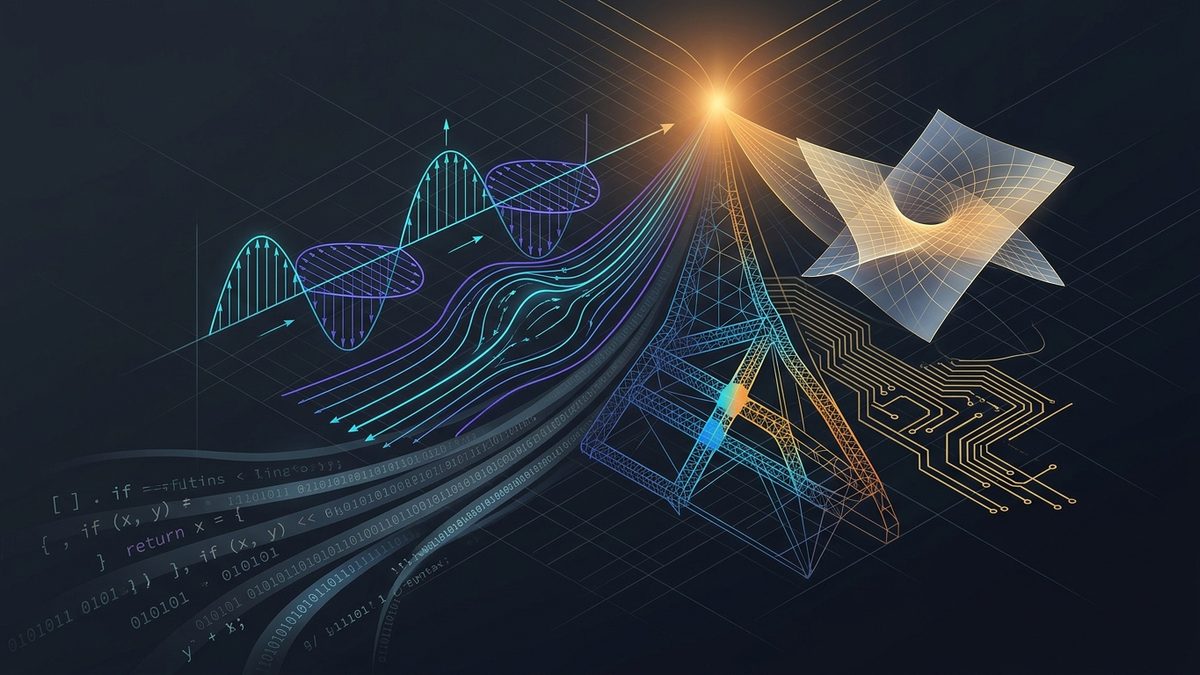
The Myth of the "Untouched" STEM Disciplines
When generative AI and Large Language Models (LLMs) first entered the mainstream, the immediate shockwave hit software development. Because these models are native to text and syntax, the public narrative quickly narrowed to a single question: Will AI replace programmers?
This created a dangerous blind spot across the rest of STEM education. Many students, educators, and professionals assumed that traditional physical and quantitative disciplines—Electrical and Mechanical Engineering, Physics, Materials Science, and Applied Mathematics—were insulated from the AI revolution.
They are not. AI has rapidly evolved beyond text generation into physical simulation, electronic design automation, and formal mathematical reasoning. However, rather than making human engineers and scientists obsolete, AI is fundamentally shifting what they do—hollowing out routine calculation while making deep, first-principles mastery more valuable than ever.
Beyond Text: AI Enters the Physical and Quantitative World
To understand where STEM careers are headed, we must look beyond chatbots and code assistants. Across R&D labs, semiconductor foundries, and defense testbeds, AI is now embedded directly into the core workflows of physical engineering and hard sciences:
Electrical & Semiconductor Engineering: AI-driven Electronic Design Automation (EDA) now designs complex microchip floorplans, routes high-density printed circuit boards (PCBs), optimizes RF signal chains, and generates production-grade hardware description code (Verilog/VHDL) in hours—tasks that previously required weeks of manual layout and verification.
Physics, Mechanical & Aerospace Engineering: Traditional Finite Element Analysis (FEA) and Computational Fluid Dynamics (CFD) require massive compute time to numerically solve partial differential equations (PDEs). Today, Physics-Informed Neural Networks (PINNs) and AI surrogate models embed conservation laws directly into neural architectures, simulating complex multiphysics, fluid turbulence, and structural stress orders of magnitude faster than legacy solvers.
Pure & Applied Mathematics: AI reasoning engines paired with formal verification environments (such as Lean) have moved far beyond symbolic algebra crunching, actively assisting mathematicians and quantitative researchers in theorem proving, boundary-condition analysis, and multi-variable optimization.
In every single STEM field, the "calculator layer" of the profession is being automated.
The New Division of Labor: Routine Calculation vs. First-Principles Judgment
In every technical field, automation is taking over routine work that can be written down as a procedure. At the same time, it makes professionals who frame problems, understand the physics, and make high-stakes engineering calls more valuable.
The result is that technical work is splitting into two layers. One layer is execution: work that follows a known method and can increasingly be handed to software. The other is judgment: deciding what problem to solve, which assumptions hold, and whether an answer makes physical sense.
The fields below are examples, not a complete list. You can draw the same line through any technical discipline by asking one question: which parts of the work follow an established procedure, and which parts require deciding what the procedure should be?
Discipline | Work Software Increasingly Handles | Work That Still Requires Human Judgment |
|---|---|---|
Computer Science | Boilerplate code, CRUD endpoints, routine unit tests, syntax-level debugging | System architecture, state modeling, security boundaries, algorithmic trade-offs |
Electrical / Telecom | Standard HDL blocks, routine RF link budgets, automated PCB routing | Electromagnetics, information theory, hardware–software co-design, thermal and power limits |
Mechanical / Civil | Standard CAD drafting, FEA/CFD mesh generation, lookup-table sizing | Continuum mechanics, thermodynamics, failure-mode analysis, safety-critical validation |
Math & Physics | Symbolic integration, standard PDE solutions, statistical curve fitting | Choosing assumptions, formulating the problem, setting boundary conditions, checking physical validity |
If a student’s education consists entirely of memorizing formulas and plugging numbers into software tools—what we might call "button-pushing engineering"—their career is directly exposed to automation. Conversely, the engineer who understands the underlying physics and mathematical proofs becomes a force multiplier, using AI to explore thousands of design permutations in the time it once took to calculate one.
The "Jagged Frontier" and Why Nature Cannot Be Sweet-Talked
Why can’t AI simply run the entire engineering pipeline autonomously?
Because AI capabilities operate along a jagged frontier. An AI model does not expand its knowledge in a smooth, predictable circle; it can effortlessly solve a graduate-level differential equation on one prompt, yet hallucinate a basic violation of conservation of energy, structural fatigue, or impedance matching on the very next step. When engineers rely passively on AI without deep foundational knowledge, they become blind to where that invisible frontier lies.
In software, a hallucinated UI component is a minor bug that can be patched in minutes. In physical engineering and applied sciences, nature cannot be sweet-talked:
An RF communication link that violates Shannon’s limit or ignores phase noise and multipath interference will fail in the field, no matter how confidently an AI generated the link budget.
A structural truss or thermal heat sink optimized by a generative algorithm without proper real-world boundary constraints will fracture or overheat under load.
To catch an AI when it crosses the jagged frontier, the human in the loop must possess a deeper, more intuitive grasp of first principles than ever before. You cannot audit an algorithm using knowledge you only memorized for a multiple-choice exam.
Preparing for AI-Era STEM: Returning to Praxis
The rise of AI across engineering, physics, and mathematics demands a fundamental overhaul of how we learn technical subjects.
When handheld calculators were introduced, mathematics education did not disappear—it shifted away from manual long division toward algebraic reasoning and calculus. Today, AI is the ultimate universal calculator. Surviving and thriving in a modern STEM career requires moving from passive memorization to praxis—the continuous, active integration of theoretical first principles (theoria) with hands-on, verifiable execution:
Master the Constraints, Not Just the Formulas: Instead of memorizing how to execute a textbook procedure, learners must understand why an equation holds, what physical assumptions it relies upon, and where its boundary conditions break down.
Develop "Back-of-the-Envelope" Intuition: Before trusting a generative CAD model, a multiphysics simulation, or an AI-generated code block, a first-principles practitioner uses dimensional analysis, order-of-magnitude estimation, and physical intuition to sanity-check the machine's output.
Train in Interactive, Socratic Environments: Passive video lectures and static LMS quizzes train students to recognize familiar patterns—the exact skill AI has already commoditized. Interactive workspaces that challenge learners to derive, build, debug, and defend their reasoning on a live canvas build the cognitive resilience required to command AI tools safely.
The Golden Age of the First-Principles Engineer
AI is not the end of STEM careers; it is the end of rote STEM careers. By automating the tedious mechanics of drafting, syntax, and routine computation, AI frees engineers, physicists, and mathematicians to operate at the highest level of human ingenuity.
At Praxium Academy, our mission is to cultivate the exact cognitive architecture that AI cannot replicate. By grounding every learner in deep, interactive first principles and real-time praxis, we prepare the next generation of STEM leaders not merely to compete with artificial intelligence—but to direct it.
Comments
Sign in to join the discussion.